Loading...
Loading...


The editorial, titled "The Human Dimension in Poetry," emphasised that poetry regains its original position, vitality, and vibrant colours, as well as its influence throughout history, especially when it is interwoven with human issues, the details of daily life, and strength. It becomes the truest mirror of the human spirit, suffering, and feelings, and the most attentive and receptive to human voices, laments, and fears. It transforms into an idea and a value emanating from the heart, freed from rigidity, to express with warm and profound emotion longings, dreams, memories, pains, and struggles.
As for the managing editor, Nawaf Younes, in his article "Acquaintance Before Civilisational Dialogue," he pointed out that acquaintance, and subsequently dialogue, is fundamentally based on mutual respect, without excluding the other, and acknowledging their existence and influence, despite the differences and variations. This stems from the understanding that the East is a civilisation and the West is a civilisation, and while they are distinct, they are not one civilisation. However, this does not lead us to adopt the idea of a clash of civilisations as it is presented in the West, because each possesses its own systems, identity, character, and human culture. The East and the West are indispensable partners on the path of convergence between human civilisations for the betterment of humanity.
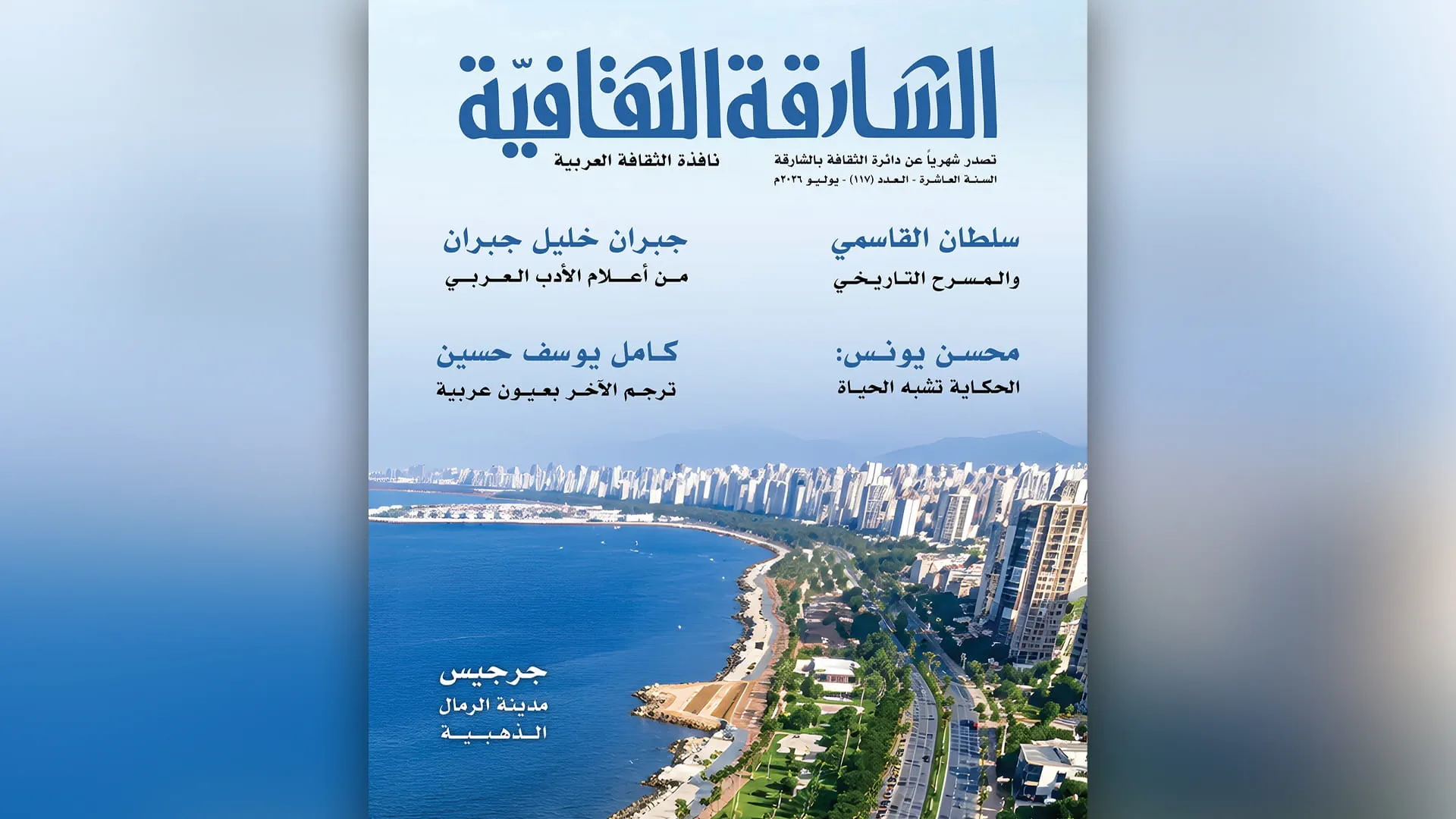
In this issue, Hussein Hammouda explored the journey of pain, contemplation, and creativity in the work of Khalil Gibran. Sawsan Muhammad Kamel wrote about Sadiq Jalal al-Azm, a pioneer of Arab thought and culture. Khaled Awad al-Ahmad toured the city of Ma'an, the rose of southern Jordan and the jewel of its desert, while Hassan bin Muhammad offered a glimpse into the city of Zarzis, one of the most prominent tourist destinations in Tunisia.
In the "Literature and Writers" section, Khalil al-Jizawi interviewed novelist Mohsen Youssef, who stated that the Sharjah Cultural Forum celebrates intellectuals in their own countries. Abdullah al-Muttaqi also interviewed novelist Shafiq al-Tarqi, who affirmed that combining genres is a valid practice.
Bahija Masri Idlibi wrote about Dalal Hatem, whose childhood awakened her to dreams and creativity. Ibrahim Farghali discussed the act of translation in Kamel Youssef Hussein's work as a bridge for cultural communication. Nasreen Antonios explained how Mubarak Al-Rabi' transported the story to the realm of narrative, revealing human weakness and questions. Samer Anwar Al-Shamali wrote about the experience of the writer Afrah Al-Hindal, who writes with a freedom open to experimentation. Ziad Al-Rayes explored the secret of the sea in Salah El-Din Boujah's novel "The Slave Trader." Etedal Othman examined Sherine Abu Al-Naga's project, which re-establishes the relationship between literature and humanity. Nabil Suleiman explored the secret of creativity in Ivo Andrić's novels "Chronicle of Travnik" and "The Bridge on the Drina." Adel Al-Batousi wrote about Najwa Barakat, who writes literature from within with the awareness of a creative artist. Abdul-Razzaq Al-Rabi'i continued to bring the works of the late poet Mubarak Al-Amri from the Omani archives to library shelves. Dr. Majd Haidar wrote about Ahmadou Koroma, one of the greatest storytellers and narrative voices in African literature. Dr Saleh Huwaidi presented a reading of the novel "Years of the Maghreb" by writer Maryam Al-Zarouni, focusing on characters searching for identity. Abdel-Alim Haris wrote about narrative identity and what we tell about ourselves. Muhammad Fouad Ali examined the character of Juha, beloved by the people and a rich source of inspiration for storytellers and biographers. Faraj Abdel-Wahab reviewed the biography of Subhi Al-Jayyar, a writer and translator who received the State Encouragement Award. Munther Yahya Issa celebrated the creativity of Jumana Naaman, who dedicated her life to childhood and writing for children. Heba Muhammad wrote about Elias Farkouh, a literary icon in Jordan and a unique voice in the world of Arabic narrative. Hisham Azkid interviewed the Moroccan writer Ismail Ghazali, whose writing focuses on self-discovery and exploring the world. Zakaa Mardali wrote about the modern novel in the Arab world and how it poses questions with a fresh perspective. Ali Sakr discussed the career and genius of Dino Buzzati and his world built on paradox and symbolism.
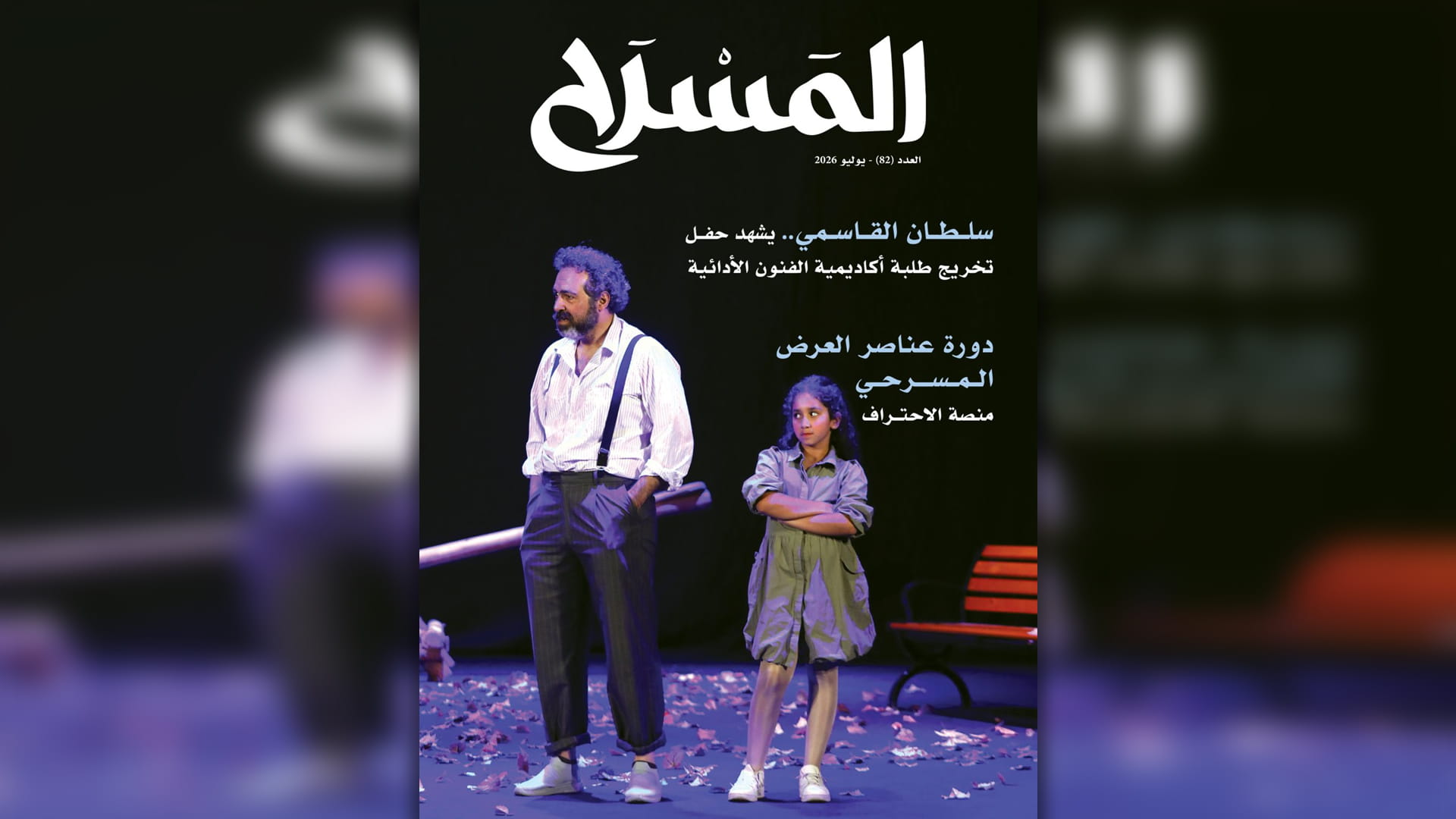
In the "Art, String, and Brush" section, we read articles about visual arts, theatre, cinema, music, and drama: Sultan Al Qasimi and Historical Theatre (Malik Saqour), Dibba Al Hisn Hosts the Ninth Edition of the Duo Theatre Festival (Dr Salma Al Nour), "Adagio" and an Endless Journey of Creativity (Nour Ghanem), Hamdi Moussalli: Theatre is the Art of Life (Hassan M. Youssef), Maysaa Mohammed: Her Paintings are a Window into the Soul (Dr Mahmoud Shaheen), "Wuthering Heights": A Film with a Contemporary Vision (Osama Asal), and The Equation of Cinematic Creativity Between the Mindset of the Producer and the Artist (Ezz El-Din Al Aswany).
In the "Under the Spotlight" section, we feature readings and publications including: "The Image and Its Impact on Text Construction" (Nadia Omar), "Intisar Abbas's Obsessions in 'A Tree Forgotten by the Wind'" (Basem Suleiman), "Anxious Literature and the Characteristics of Creativity" (Iman Mohamed Ahmed), "Before We Begin... A Narrative for Establishing Science Fiction Literature" (Amani Ibrahim Yassin), "My Little Treasure: The Art of Presentation and Aesthetics" (Thuraya Abdelbadi), "The Novel and the Arab Rural Village" (Abrar Al-Agha), "Ancient Civilizations" (Najla Mamoun), and "The 'Mountains of Kohl' Sequence" by Camelia Abdel Fattah (Dr Hanan El-Sharnoubi).
On another note; The issue included a collection of articles: The Poetic Image in the Works of Sayer Ibrahim (Younes Muhammad Ibrahim), Ahmed Darwish and Abdul Qader Al-Qatt: A Critic's Reading of a Critic (Mustafa Abdullah), World Literature Magazine: A Window on the Arab Literary Scene (Abdul Nabi Istif), Ahmed Youssef Daoud: A Glimpse into His Thought and Poetics (Ghassan Kamel Wanous), Ziad Abu Laban: Embodies Realism with High Symbolism (Intisar Abbas), I'tidal Rafe': A Woman Writing Humanistic Literature (Rose Makhlouf), Maitham Al-Khazraji: Tracing Memory in "Displacement Towards the Possible" (Dr Huwaida Saleh), The Culture of Human Relations and Balance with Technological Progress (Sami Mahmoud Taha), The Roots and Origins of the Novel (Hani Bakri), Between Shaw's Realism and Hemingway's Irony (Youssef Ali Al-Ghadban), and Al-Akhtal Al-Saghir: A Unique Poetic Progeny (Lorca Speyt) Has the Era of the Star Poet Ended? (Tawfiq Ahmad), An Artistic Interplay Between Criticism and the Novel (Asmaa Al-Masfar), Metaphor, Symbolism, and the Magic of Meaning (Rana Kamal Al-Asali), The Formation of the Short Story and Narrative Generation (Dr Asmaa Badr), The Dialectic of the Written and the Oral in Arabic Poetry (Paul Shaoul), Creativity and Summer Nights (Raad Aman), The Role of Theatre Festivals in Strengthening Arab Communication (Magdi Mahfouz), Bridges of Awareness and Visions of the Future (Mohammad Rabie Hammad), Theatre Between the Traditional and the Experimental (Louay Shana).
The issue dedicated space to a collection of short stories and translations by a constellation of Arab writers and creators.

 For an optimal experience, please
rotate your device to portrait mode.