Loading...
Loading...


Expanding architecture beyond questions of buildings and form, Architecture Otherwise foregrounds social, cultural and political infrastructures to examine how communities emerge and grow. Participants will examine migration, displacement, care, food systems, heritage, public space, climate adaptation, mobility, education, spirituality and collective memory, presenting architecture as an evolving practice rooted in people and relationships. Participants will engage with Sharjah’s layered urban fabric, with some projects developed as part of longer-term residencies, grounding the Triennial in local context.
Several projects investigate what it means to build under conditions of movement, uncertainty and transience. Hiba Bou Akar, Mohamad Hafeda and Nathalie Harb examine how histories of displacement in Lebanon can be carried within mobile, shelter-like installations that incorporate materials from refugee settlements and wartime infrastructures. Aslıhan Demirtaş, Ali Cindoruk, Dilşad Aladağ (Istanbul, Turkey) present a new iteration of Tumblespace, a moveable and adaptable structure informed by traditions of nomadism that creates temporary communities and dialogue.
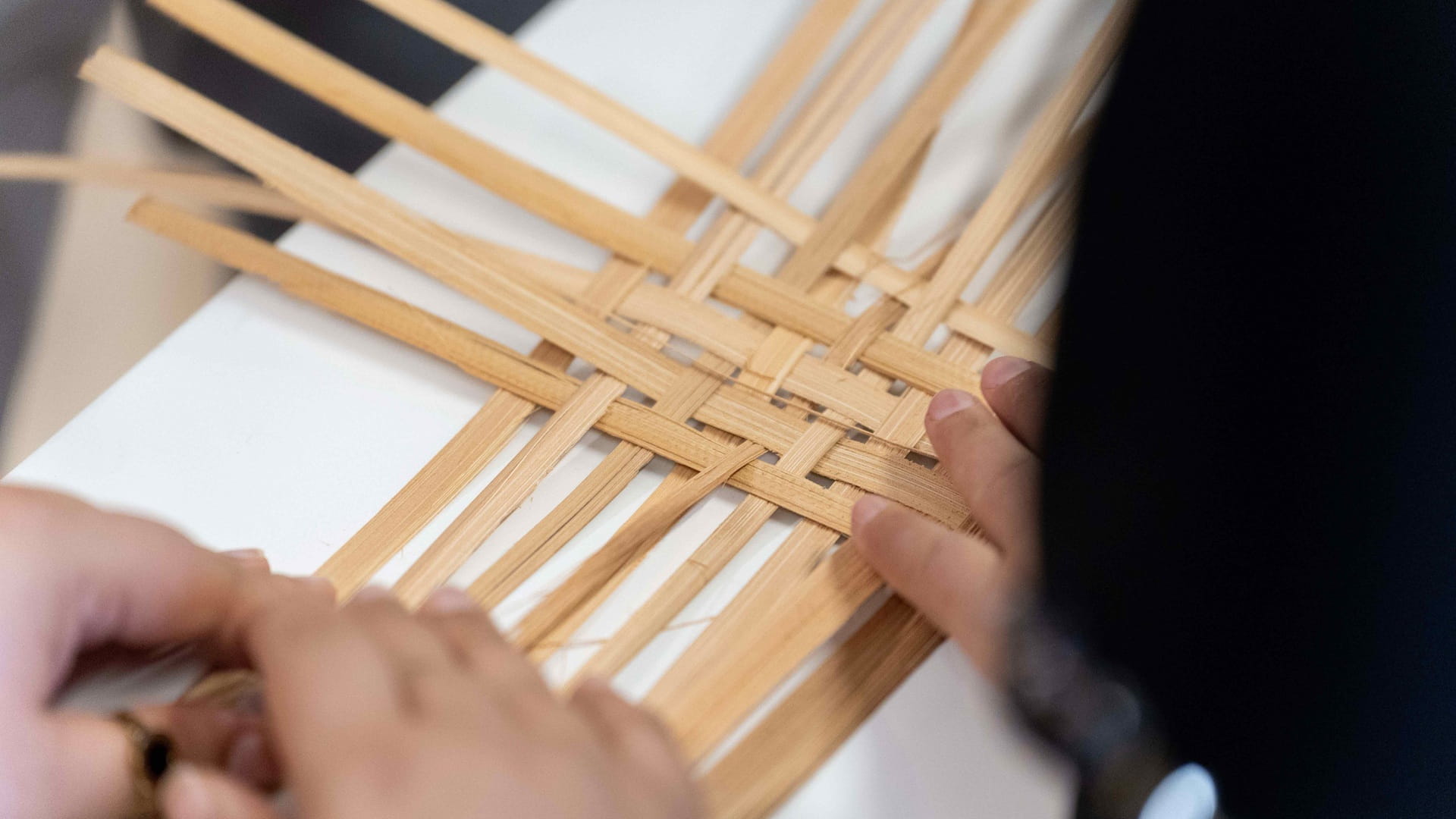
People's Architecture Office (China/US) reconceives everyday flatbed handcarts used for transporting goods as vehicles for both movement and gathering, which can support communal activities such as dining and theatre performances. ABARI presents Weaving Spaces, a monumental bamboo structure that can be dismantled. Over the course of the Triennial, the structure will move across several locations in Nepal, hosting workshops to celebrate the woven bamboo tradition of Nepal. Sa'dia Rehman presents There Isn’t a Stone I Don’t Remember (2022), a film about her family’s displacement from Pakistan when the state constructed the Tarbela Dam, and an artist book exploring mobile forms of civic infrastructure that emerged in the region after the dam inundated villages, including her father’s ancestral home.
Other participants examine the impacts of large-scale infrastructural development on people and environments. Kush Badhwar's film project explores the ecological and social consequences of the Navi Mumbai International Airport development, weaving together perspectives and voices of affected communities over time. In a major photographic archive, Rajesh Vora and the National Institute of Design revisit six decades of the Sabarmati River in India – once a valued site of water, seasonal rhythms and economic activity – and how recent urban redevelopment transformed its relationship with the city.
In their focus on human experiences of the city, many projects highlight the importance of placing local communities at the centre of urban development. Megawra Built Environment Collective in collaboration with RIWAQ (Cairo, Egypt) bring together practitioners from Egypt and Palestine to explore how heritage in historic cities is shaped through communities and migrant populations, rather than built form alone. Aga Khan Award-winning POCAA (Dhaka, Bangladesh) champions co-creation as a model for planning and placemaking, while Social Design Collaborative (Delhi, India) will work with migrant communities in Sharjah to imagine alternative urban futures. Tanya Zack, Mark Lewis and Thireshen Govender examine how residents actively shape Johannesburg's urban landscape outside dominant economic frameworks. Cassim Shepard's documentary Housing Agency: Mumbai’s Incremental Neighborhoods revisits collaborative approaches to housing developed in India during the late twentieth century, as a hopeful blueprint for future generations amid today’s housing precarity.
Against this backdrop, other projects focus on the communities that emerge within cities and the social infrastructures that sustain them. Another Empty House (Kerala, India/Dubai, UAE) examines Gulf Malayali gathering cultures through “Koottaymas”, self-organised networks of care and support within migrant communities. Karachi LaJamia creates a nomadic community reading room that shares histories of resistance, ecological knowledge and learning from Pakistan, while Kishwar Rizvi documents the city of Karachi's gymkhana social clubs as sites of memory, conservation and civic repair.
Other participants imagine new civic futures through technology, education and creativity. Azza Aboualam (Sharjah, UAE) – building on her project at the Venice Architecture Biennale in 2025 – presents Assemblies, a speculative greenhouse system exploring food production and self-sufficiency in arid environments. Nashin Mahtani/Disaster Map Foundation presents a film about PetaBencana - a real-time disaster-mapping platform for Indonesia - considering how open-source software can function as a form of civic infrastructure for climate adaptation and collective resilience. Curry J. Hackett reflects on Black schooling in the US to reconsider educational institutions as civic stages for new relationships between communities and learning; Sri Lanka-based Let's Build Great Things! works with children from diverse groups in Sharjah to construct a temporary public structure; and Kevin Kimwelle / Indalo World (Cape Town, South Africa / Nairobi, Kenya) explores the power of circular construction as a shared civic practice.
Elsewhere, participants will create environments for contemplation and alternative ways of experiencing the city. Badriyah Alsalem (Kuwait City, Kuwait) reimagines civic infrastructure through traditions of celestial navigation and environmental knowledge, drawing on historic ways of reading the desert sky. Mohamad Nahleh and Ozayr Saloojee explore the imaginative possibility of ‘night architecture’ – a counter to the imperialist urban skylines that dominate through discourses of enlightenment - using storytelling, performance and guided walks. Yaminay Chaudhri and Karachi Beach Radio will focus on the beach as an open, welcoming space through an installation incorporating oral history and sound, and Samar Halloum’s Sabeel, Negotiated reads everyday spatial adaptations within Sharjah’s transitional urban spaces as extensions of Sabeel, a practice of offering basic needs to passersby, learning from the ways people draw on available spaces and resources to make the city more hospitable in daily life. Sudarshan Shetty’s (Mumbai, India) video work invokes states of presence and pause amidst the rhythms of urban life, while Ziad Jamaleddine, Makram el Kadi, Iheb Guermazi and Beya Othmani (Beirut, Lebanon) will recast the “khalwa” – Sufi spaces for retreat and meditation – in Sharjah, offering a place for reflection in the contemporary city.
Extending architectural discourse into new cultural forms, several participants will create platforms for collective inquiry that position architecture as a framework for exchange, storytelling and shared knowledge. BARDStudio's Sharjah Glossary and Otherwise School develops an evolving vocabulary drawn from everyday lived experience in Sharjah, suggesting the rich complexity of urban life away from reductive administrative and economic categories. As part of a residency, a project by LionHeart (London, UK) will combine film and poetry to explore alternative forms of architectural literacy, while Torolab (Tijuana, Mexico) will present the Sharjah Cookbook, mapping territory through food systems, labour networks and everyday practices of nourishment. Keller Easterling’s (New York, US) South South Stone Soup uses the folktale of stone soup to imagine how resources can be transformed from private possessions into shared goods, connecting discussions of reparations in the US to broader solidarities across the Global South.
Other installations across the Triennial examine overlooked infrastructures that shape everyday urban experience. Brent Kokonya and Dennis Muraguri's Moving Pluralisms draws on Nairobi's matatu transport system as a mobile architecture of belonging and social encounter. Chloë Bass and Bill Dietz transform public address systems into polyphonic sound installations that amplify multiple voices and forms of shared listening.
Together, the participants of SAT03 propose new understandings of architecture as a practice grounded in collective life, demonstrating how civic infrastructures are continually produced through acts of care, imagination, movement, learning and solidarity.
Further Special Programming for the Triennial, including talks and film screenings, will be announced separately.

 For an optimal experience, please
rotate your device to portrait mode.