Loading...
Loading...


The first response took the form of the infamous Scroll Monument. Conceived as a standalone landmark, the scroll was designed to mark Sharjah’s global recognition as a centre of books, learning, and knowledge production. Positioned prominently within the urban landscape and on the emirate’s busiest highways, it signalled the moment of recognition.
What followed was more ambitious. Rather than allowing the scroll to remain a symbolic endpoint, Shurooq treated it as a starting point. The question shifted from representation to application: how could the idea of knowledge move from monument into daily use.
The answer became the House of Wisdom.
Delivered in 2020, the House of Wisdom was developed as a permanent civic institution that gives operational meaning to the symbolism of the scroll. The two elements were conceived as a sequence rather than a composition. One marks achievement. The other sustains it.
To realise this ambition, Shurooq appointed the global architecture firm Foster + Partners, whose approach to civic and cultural architecture aligned with the project’s emphasis on longevity, adaptability, and public use.
According to Khawla Al Hashimi, Chief Projects Officer at Shurooq, the project did not begin with architectural form. “We did not start by designing a building,” she said. “We started by defining how knowledge is accessed, shared, and produced today.”
This methodology reflects Shurooq’s broader development philosophy, where architecture is deployed as a civic framework rather than a visual statement.
The House of Wisdom houses a combined physical and digital collection exceeding half a million titles, but its programme was intentionally expanded beyond storage and circulation.
In addition to reading areas, the building integrates lecture halls, discussion rooms, exhibition spaces, fabrication and prototyping labs, and informal learning environments. These functions were not layered onto the building, but structured as core components of its spatial logic.
Spatial zoning reflects how learning actually occurs. Open areas support dialogue and exchange, while enclosed reading nooks accommodate prolonged concentration and quiet study. This balance between exposure and retreat informed the plan at every scale.
Dedicated spaces such as the Ladies Lounge were developed following direct consultation with users, addressing specific cultural and comfort requirements within a shared civic setting. “Inclusivity was not addressed through policy,” Al Hashimi noted. “It was resolved through space, proportion, and adjacency.”
Braille books are fully integrated into the main collection rather than separated, reinforcing a single system of access rather than parallel provisions.
Architecturally, the House of Wisdom reflects a restrained and highly controlled design language. Organised around four primary structural pillars, the building is defined by a disciplined geometric order rooted in symmetry and proportion, drawing on Islamic architectural logic without literal reference.
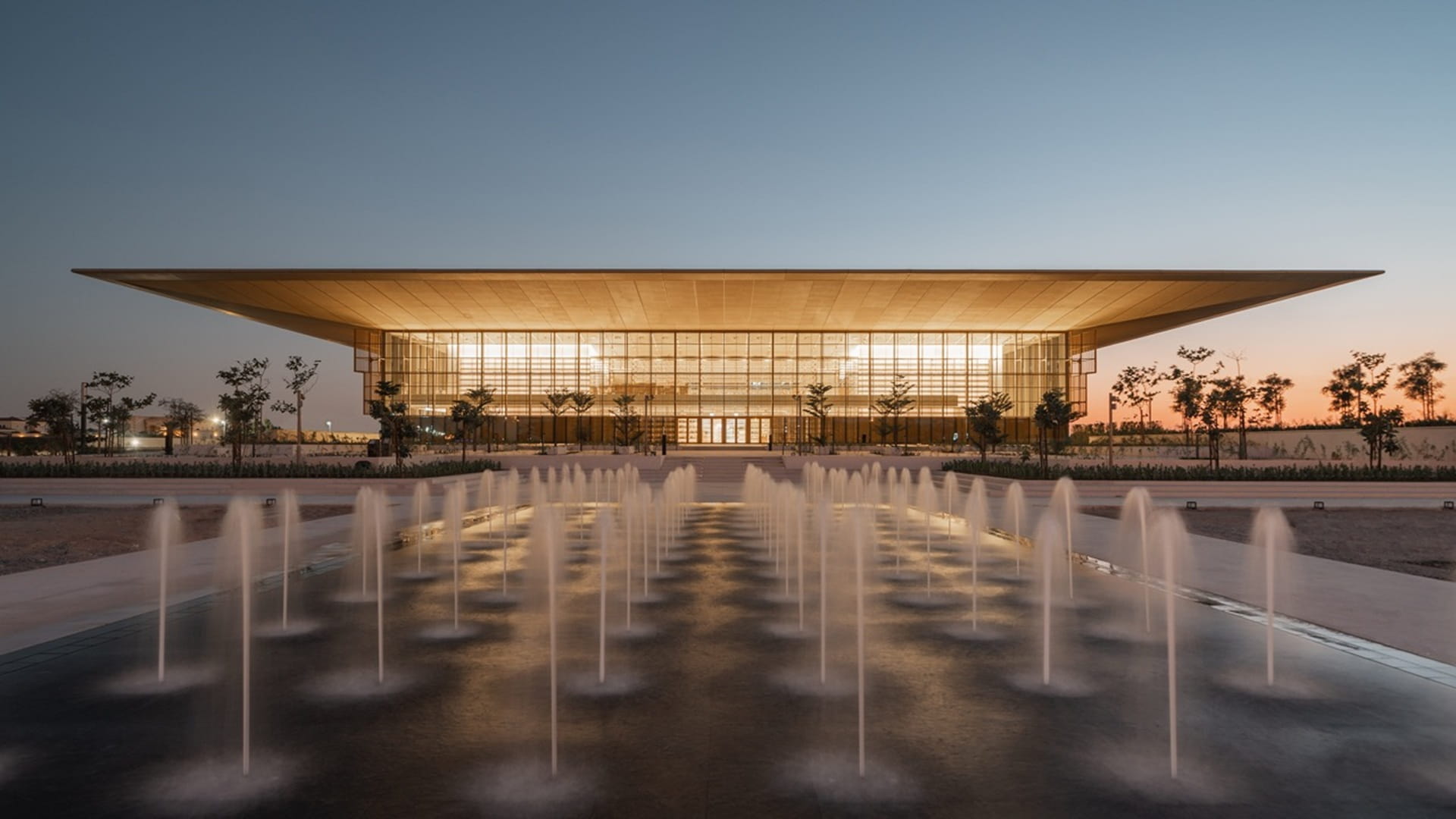
Environmental performance was a determining factor in shaping the building. Foster + Partners designed the building as a transparent volume shaped by straight lines, sheltered under a 15-metre roof that appears to float above it. This deep overhang is not only for aesthetics; it serves an important function by shading the façades for most of the day from the hot sun.
Meanwhile, fixed aluminium screens of varying densities filter the low evening sun. At ground level, moveable bamboo screens on the inside allow users to adjust privacy and glare from the sunlight, preserving uninterrupted visual links to the surrounding gardens when fully open.
Structurally, four primary cores support the expansive roof and consolidate all services and functions, enabling column-free floorplates across both levels. Within the entrance cores, sculptural staircases guide vertical movement to the mezzanine, where suspended pod-like rooms accommodate quiet study zones, collaborative spaces, reading lounges, a prayer room, and a women-only area.
A central courtyard acts as both a climatic and spatial regulator, introducing daylight and air while structuring circulation and moments of pause within the building.
“Light had to guide movement and mood,” Al Hashimi explained. “But it also had to be restrained. Books require protection just as much as people require daylight.”
Throughout the building, the architects prioritised visual openness, framing consistent views of the landscaped grounds. To the south, a knowledge garden and children’s play area incorporate native planting and water features. To the north, a formal geometric garden frames The Scroll sculpture, reinforcing the spatial dialogue between symbol and institution.
The building was also designed to register time. By day, it reads as a calm, grounded civic structure. By night, controlled internal illumination allows it to glow outward, reinforcing the idea of knowledge as something shared rather than contained.
Explaining the interplay between the design and function of the House of Wisdom, Gerard Evenden, Head of Studio, Foster + Partners said: “The House of Wisdom in Sharjah is a forward-looking conception of what a library should be in the 21st century – embracing a digital future while playing a crucial role as a community hub for learning, underpinned by innovation and technology. The straight, minimalist lines of the building complement the dunes of the desert, set within a lush landscape. The House of Wisdom is set to be an oasis for the local community, led by research and innovation, at the heart of a new cultural district.”
While the House of Wisdom has become one of Sharjah’s most recognisable contemporary buildings, Shurooq did not define its success through image alone. Performance was measured by use, duration of stay, and the diversity of activities unfolding within the space.
“It is easy to create a landmark,” Al Hashimi said. “What is difficult is creating one that people return to repeatedly and incorporate into their daily routines.” This principle reflects Shurooq’s wider portfolio, where architecture is expected to operate as civic infrastructure rather than isolated object.
Seen together, the Scroll Monument and the House of Wisdom articulate a single idea through two distinct forms. The scroll announces Sharjah’s place in a global intellectual narrative. The House of Wisdom sustains that narrative into everyday life.
What began as a symbolic marker evolved into a functioning knowledge environment. In doing so, Shurooq demonstrated how cultural development can move beyond commemoration, using architecture to sustain meaning, use, and relevance over time.

 For an optimal experience, please
rotate your device to portrait mode.