Loading...
Loading...


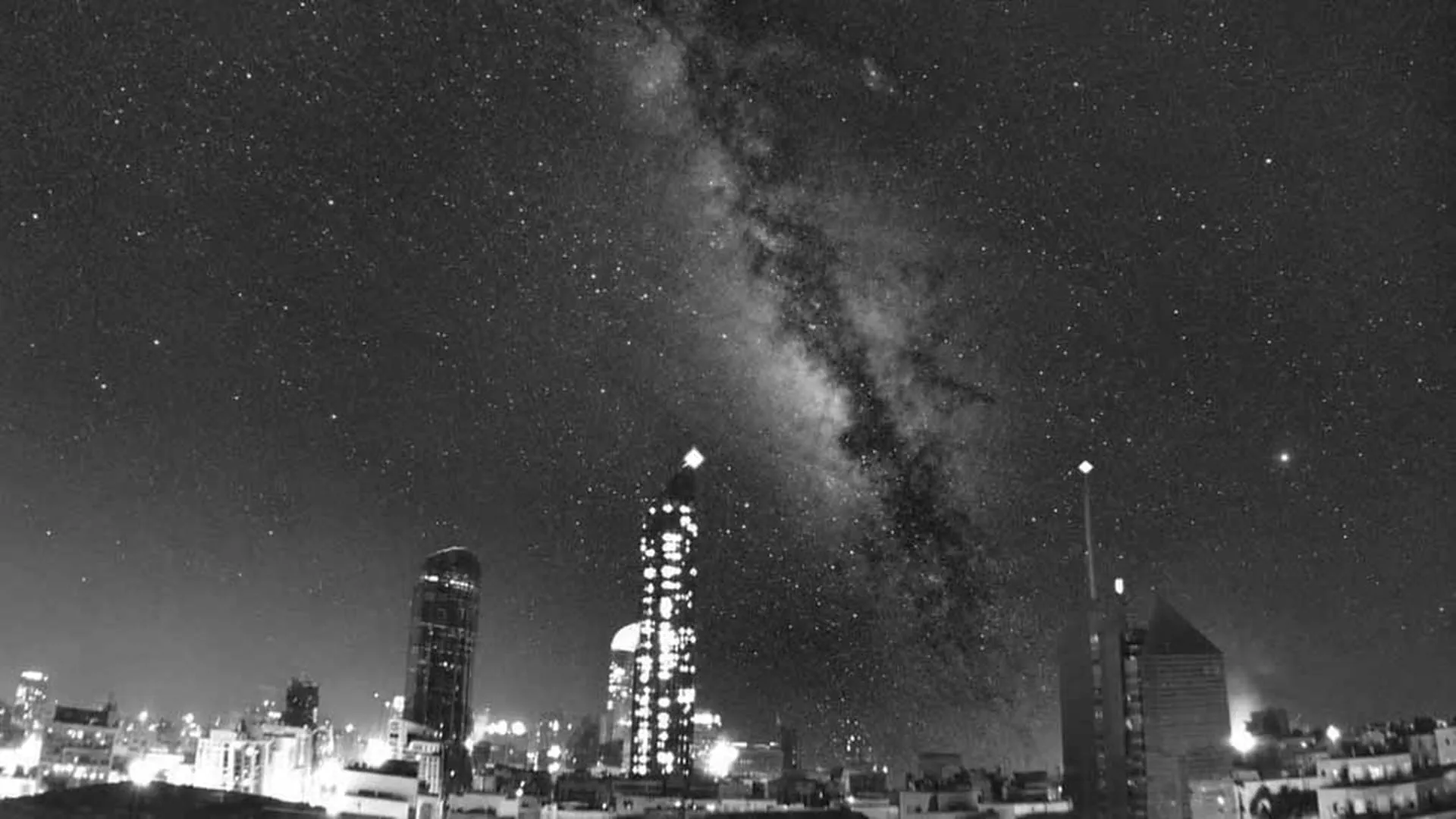
The image includes most of the Scorpius constellation and wide sections of Sagittarius, where the centre of the Milky Way lies approximately 26,000 light-years from Earth.
Engineer Mohammed Shaukat Awad, Director of the International Astronomy Centre, said the image reveals dense stellar fields towards the centre of the galaxy. He explained that large parts of this region are obscured by dust spread throughout the Milky Way when observed in visible light.
Infrared radiation, he noted, has a greater ability to penetrate dust, allowing stars and regions that are difficult to observe in visible light to be seen more clearly.
The observation was conducted using a highly sensitive monochrome astronomical camera equipped with an infrared filter. This helped partially mitigate the effects of light pollution in urban environments while retaining light from large numbers of stars and highlighting their details.
The final image consists of 180 frames, each with an exposure time of 10 seconds, for a total exposure time of 30 minutes. The frames were digitally combined and stacked using a wide-field lens with an equivalent focal length of 19mm, allowing a broad area of the sky to be captured.
Several Abu Dhabi towers also featured in the image, including the Mohammed bin Rashid Tower.
The experiment demonstrates how modern digital imaging and processing techniques can be used to observe certain astronomical details from within cities, without making urban skies a substitute for dark-sky astronomical sites.
It also highlights the importance of selecting the appropriate spectral range, using high-efficiency sensors, and stacking a large number of frames to partially mitigate the effects of light pollution.

 For an optimal experience, please
rotate your device to portrait mode.